The Question and An Answer
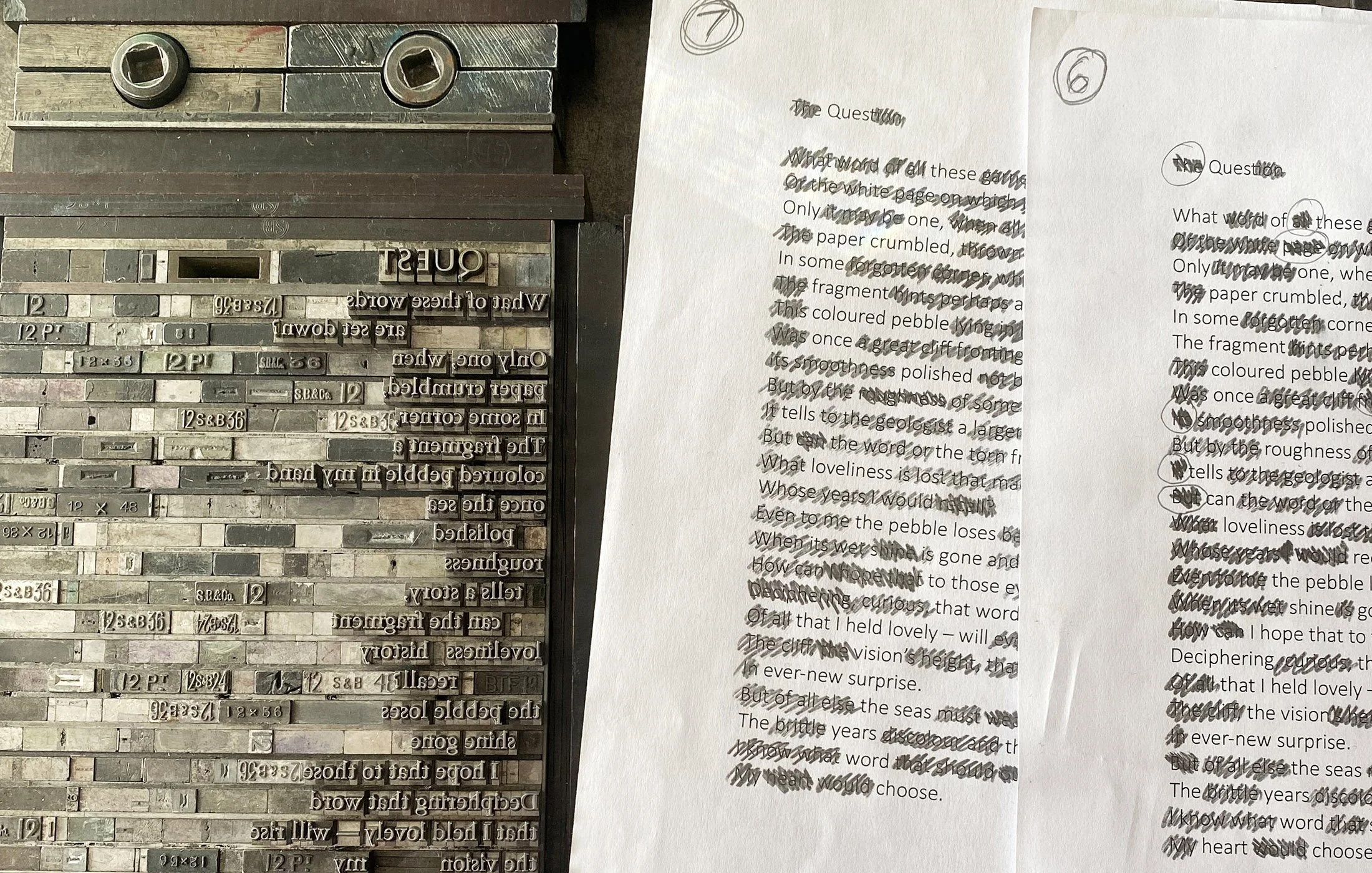
This is a letterpress printed artist’s book that starts with ‘The Question’, a poem by Mary Stella Edwards, on the first page, then gradually removes words until just one word remains on the final page. The poem starts ‘What word of all these garnered words will last…’ and as I was sitting in the Ackland and Edwards archive at the time, surrounded by her words in letters and journals, I had this rather wicked idea…
Edwin Morgan’s poem ‘Archives’ showed me a way to proceed. It’s a concrete poem with the repeated words ‘generation upon’ losing more and more of the letters as it goes. One online version closes-up the gaps between the lost letters, which feels closer to my own archive experience. You may know that things are missing in an archive – but what about all missing things you don’t know about? I wondered whether letterpress printing the poem repeatedly, taking out words as I went, until just a single word remained on the last page might give some kind of ‘An Answer’.
Animation of the pages of ‘The Question and An Answer’ from page 1 with the whole poem, to page 12, with a single word from the poem remaining.
I used a lightbox, erasing around 15 words per iteration – making sure that each new version of the poem still made sense. As I typeset the words, I closed-up the gaps created by the missing words so that it wasn’t obvious which had gone. Later I relaxed this rule, allowing the words to find their place on the page.
Most erasure poems keep the redactions clearly visible in the form of gaps where the words should be – that is why it is so often used to highlight social injustices, such as in Tracy K Smith’s 2018 collection Wade in the Water. It felt particularly transgressive to remove both the words and the space that held them.
It was surprising how quickly the poem broke apart – and yet it always kept its integrity. Removing words didn’t improve the poem – it showed me how strong the original poem was. Rhyme was the first thing to go, but to my surprise the metre remained a strong pulse beat almost until the end.
It was much easier than I expected to erase words and for the poem to still make sense. The further the experiment progressed, the more contemporary the poems became. I learned how much my brain wants to make sense of the fragments.